
My Proposal for NASA
With the recent
success and popularity of NASA’s Curiosity rover’s landing on Mars on August 6,
2012, I feel like this is a good time to put forth an argument for the advocation
of NASA’s potential and usefulness. Because NASA inspires; not only does it
inspire, but there are so many so-called “trickle-down” technologies which are
in existence because of the direct result of NASA research and ingenuity. Among
these are advances in artificial limb technologies, improved radial tires,
video enhancing and analysis systems for both law-enforcement and military
applications, firefighting equipment for more light-weight breathing
apparatuses, radio communications, what is now called “memory foam”, enriched
baby food, water purification systems, and of course some of the most obvious
technological benefits such as satellite communications and GPS, many of which
are so widely used and relied upon today in our world that it’s hard to imagine
them not having been developed in the first place.
I understand
that one of the biggest (and most reasonable) concerns over space travel is, to
put simply, cost. Among many things, certainly of great particular concern, especially
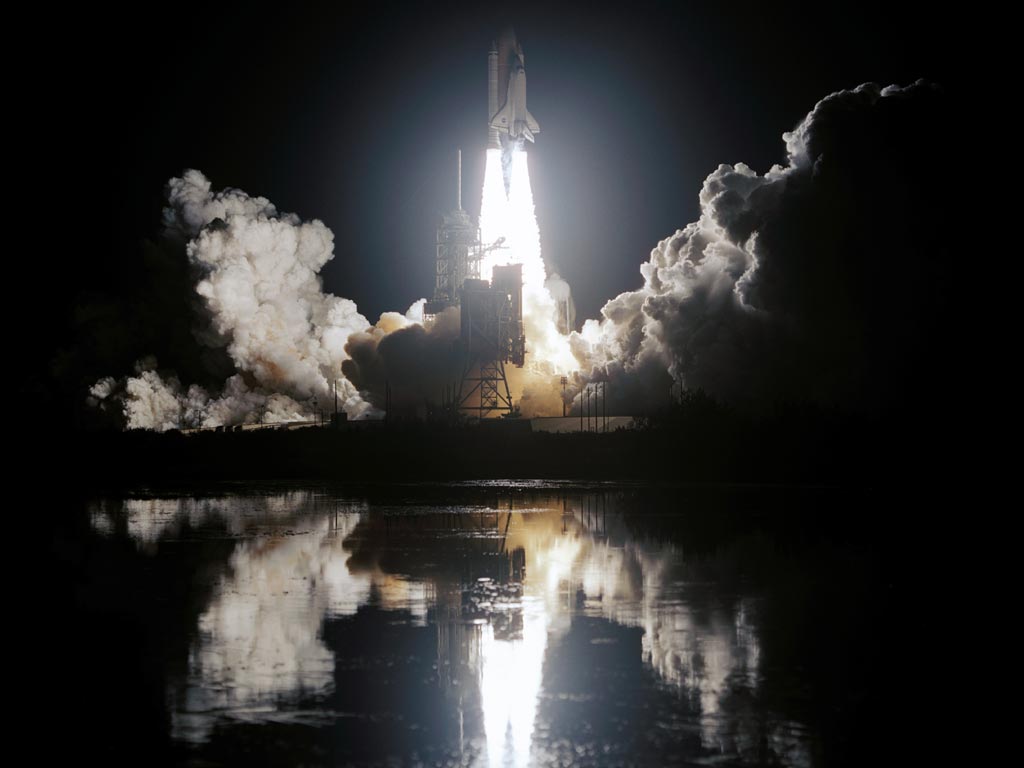
these days, is the cost of the fuel. Not only is it wildly expensive (a single Shuttle
launch reportedly cost about 1.1 billion dollars), but the fuel could
presumably be used elsewhere. And that's fair enough, for sure; I don't think
anyone could argue the validity of that concern. However, I strongly believe
that the cost is justified.
So because of
the admittedly immense cost of space travel endeavors as they are today, and of
my sympathy with the associated concerns, I'd like to propose a gesture not
totally unlike the "moments of silence" which have long been observed
to pay tribute to various tragedies.
The Space
Shuttle reportedly consumed three and a half million pounds of fuel per launch.
This is definitely a lot of fuel… staggering, in a way, to think that this is
for a single launch. However, in one
day in the United States there is an estimated two and a half billion pounds of gasoline consumed.
Simplifying the math will lead you to a ratio between the two, which shows that
a single Shuttle launch is equivalent to just barely over two minutes of U.S.
gasoline consumption:
2,500,000,000,000 lbs / 1440 minutes =
1,736,111.111 lbs/minute (fuel consumed per minute)
3,500,000 lbs / 1,736,111.111
lbs/minute = 2.016 minutes, or 121 seconds
So I propose
that on some appointed day, probably on the day of a launch, to maximize the
symbolism, every American operating a gasoline-consuming vehicle pulls over and
shuts off said vehicle (safely, of course) and observes a moment of admiration
for a mere two minutes and one second. Those measly 121 seconds represented the
entire cost of fuel for the launch. Once two minutes and one second have
passed, everyone will resume their day with a profound sensation of
accomplishment resting in their hearts, warming their souls, renewing their
faith in the power of human potential. Because in that brief period of time the
entire fuel consumption of the launch was not
being guzzled away by the citizens of the entire nation. In a vague sort of
way it’s almost as if we paid for it
entirely.
And I realize
that this is ridiculously absurd. But I like the idea behind it, the gesture
itself, the implications of what two minutes of us not aimlessly driving
ourselves around can amount to. Of course the cumulative effort and cooperation
of every single American is pretty much as far-fetched a thing to hope for as
can be imagined, not to mention the fact that no money would actually be
"saved" by this gesture; most people are still going to resume their
drive and use up the same amount of fuel they would have anyway. Also, the
Shuttle is now phased out of use completely, so the analogy is somewhat
weakened by that. But the numbers could easily be manipulated to account for
whatever newer vehicle is used, once they get developed. It won’t likely be too
much different, although they will hopefully be more efficient and less
demanding.
Speaking of
collective effort, I have another proposal, one I am much more serious about. I
believe it to be much more practical and, granted, probably at least as much
more controversial. If every American adult was made to pay a sort of "NASA
tax" of ten dollars each year, this would amount to about 2.5 billion
dollars (estimates of the adult population
of the United States is about 250 million). For perspective, the estimated cost
of the Voyager program, perhaps the most important of any non-human mission so
far, was about one billion dollars. Many have been cheaper, and some will
definitely be more expensive. Of course the Apollo and Shuttle programs were
exceedingly expensive. But space exploration involving human astronauts will
always be much more expensive than robotic alternatives, and I think both
should be pursued simultaneously and cooperatively. For more perspective, the
2012 budget for NASA is 17.8 billion dollars, slightly less than half of one
percent of the national budget. This direct contribution from the public would
increase the budget by about 14%, nudging the total over twenty billion—higher
than it’s been, adjusted for inflation, since 1969, the year we first landed on the moon.
Also worth
noting, the entire cost of the brand new (and so far wildly successful) Curiosity
rover’s mission to Mars is said to be approximately 2.5 billion dollars—precisely
the amount this action would revenue each
year.
What is ten
dollars to any one person, really? Certainly for any "average"
American this is a measly amount of money--though I would not want to advocate
any dismissal of the value of money when the issue might actually be quite
serious. But how often does one of us go out to eat and spend close to, or more
than, ten dollars? Or buy six sodas over time, or one movie ticket, or one CD
or DVD, or 1/6 of an XBox game? I could lose ten dollars out of a hole in my
pocket and it would have no lasting effect, if I even noticed it missing at
all, and I’m not rich by any reasonable measure. Of course there must be exceptions
to this generalization… I don't doubt there are people and families that are in
legitimate need of absolutely any ten dollars they can get. In these cases, for
situations truly this severe, I would not press the issue personally. Assuming this
policy was ever actually adopted, I imagine it would take at least some effort
of will for most people to come to terms with the justifications of the
mandatory "NASA tax." But I would hope that in most cases it would
not be much of a struggle, ideally none
at all. Maybe most people would actually grow to appreciate the investment.
And, of course, using the word “tax” in advocating this idea is probably going
to stir some resentment, but I don’t know of a better way to execute such a
plan if it could ever actually be adopted as a whole. I mean, we pay taxes
every day, on virtually everything that we ever purchase, whether it’s a measly
candy bar or a new TV or a car. Taxes are necessary for our economy’s continued
growth, budget and success. The simple term should not infuriate, it should inspire dreams for what such small
percentages of our earnings can initiate and progress with the help of our
direct influence. This is a beautiful opportunity.
Even if a
quarter of all American adults--62,500,000 people--truly cannot afford to
contribute or just outright refuse to participate because they can't find the
necessary minute shred of compassion within their blackened hearts, somehow
legally filtered out of the “taxation”, then the same 2.5 billion dollars could
be accumulated from $13.33 per person. Not so much of a change; or, if kept at
$10 per, then the sum would still be a respectable 1.88 billion dollars and it would still benefit enormously.
Or this could
be implemented as one dollar a month, or fifty cents biweekly, automatically
taken out of your paycheck (whichever applies). We could even go less extreme
and have each American adult invest one dollar at the end of the year. Just one
dollar from each of 250 million people makes quite a sum even still (250
million dollars). Even one pitiful penny
from each of us will supply them with 2.5 million dollars at the end of a year.
Or we could add to the nation-wide tax revenue even a fraction of a percent,
say one tenth of one percent, to all taxable purchases. I don’t know what that
would amount to, but surely it would be an appreciable amount over the course
of a year. If your area’s tax rate is, say, 8.75 percent, it would simply
become 8.85 percent, and would hardly even be noticeable. There are any numbers
of variations for such a policy to be implemented, any wide range of possible
contributions, investments, from the people of such a promising nation to put
forth. Each of them would provide such a benefit to NASA, or even another
yet-to-be-established space program. I am somewhat surprised and disappointed
that something like this hasn't already been adapted, but to be fair, the
funding received by NASA from the government already is pretty much a portion
of the taxes already being collected by the general public, and even this much
gets its own share of controversy.
So one could
argue that we are all already paying taxes, and, well, where do you think the
money going to NASA already is coming from? But the point is, the money is
there, in each of our possessions. I’m trying to suggest that we appreciate
that NASA is an investment of
government spending, not a “special case”, and deserves more than whatever they decide to allocate each year from
the collection of public taxes alone. NASA would still be given what the federal
budget deems worthy, valuable of course in its own right, but and then some, as an extra contribution
from the general public who so deeply wallow in the returns of this investment aggregated
over all the years it’s been utilized.
One could also
argue why NASA? Why not an organization ready to clean up the atmosphere, or
the oceans, or the forests, or the roads, or the education system, or whichever
one of countless organizations with countless goals in mind? These are all also
admirable goals, and very important, for sure. I do not mean to demean the
value of any other charity or organization. Indeed, I would encourage donations
wherever they can be given! Nothing is stopping anyone from contributing to any
of these; anyone with extra generosity can invest to their heart’s content. I
am simply advocating the addition of a small amount of money, to be carefully
determined, into the tax system specifically for the nation's space exploration
budget, and specifically for NASA, and not at the mercy of yearly budget cuts
and not factored into what the government decides to fund of its own accord. I
think this should be an independent contribution on top of what is deemed
worthy of NASA’s federal budget. I argue that the investment into NASA exceeds
virtually all other possibilities of organizations and charities of similar
“scope”/”endeavors”. I argue that this extra contribution is in all of our best interests. Because in this age, in the
twenty-first century, it seems obvious that the benefits of discoveries and
advancements are mostly all going to be showered down from the frontiers of
engineering and scientific innovations, and we need to keep that off-world
frontier burgeoning, because that is the realm from which so much of what we
cannot even anticipate is in all likelihood going to come from and work to make
this world a better place for all its inhabitants.
With so large a
population any amount of contribution, matched by all, so miniscule in each
individual case, amounts to incredible
quantities. And, especially in this case, with incredible quantities comes
incredible discoveries. Another option for NASA’s benefit is for them to host
some sort of annual Kickstarter-like fundraiser. This way the contributions
would not be mandatory, and would not be defined by a standard, but could be
absolutely anything a contributor might be willing to put forth… and, like most
Kickstarters make use of, enticing rewards could be offered to stimulate the
generosity. With a high enough investment perhaps one could even be rewarded a
tour of a NASA facility, or the witnessing of a launch, or even a trip into
orbit around the planet!
I just think
that the implications of what is out there to be found and studied, the
knowledge to gain, the unexplored worlds to really see for the first time, and
the potential for our expansion and survival, are paramount in importance. The
Earth's atmosphere is pretty much represented by the simple coat of lacquer on
a standard globe. That's it, all which separates us here on the surface from
everything out there ready to explore and discover... the frontiers of our
thoughts are out there just out of
our reach! Ready to be stumbled upon, ready to expand our knowledge of the
universe and of ourselves and of this lonely planet we inhabit so fruitfully. And
the effect on our culture is perhaps most impactful of all… because after we
first went mankind to the moon, after we first saw photos of the entire sphere
of Earth, so small and fragile suspended up there in the utterly black sky, the entire world was forever changed. We
saw the implementation of so many new laws and organizations with renewed
effort to clean up the planet, more efficiently manage our resources, and
interact with each other not as a world divided by colorfully painted borders
on the surface of a globe, but as one continuous, commonly inhabited and shared
borderless planet. Because you can’t
actually tell where one nation ends and the other begins, it’s completely
arbitrary and meaningless when viewed upon at a distance great enough to
actually observe large portions of the surface of the Earth with a single
sweeping glance. There are no borders. And
we finally saw this in its entirety when those first photos from sufficient
distance were published. We began to truly understand that we are all one, we
are all together, we are all striving to survive and make the best for
ourselves on this enormous, bountiful world. But we need help to keep on
advancing and improving the quality of life the world over… and it seems like
NASA is one of, if not the prime
candidates to continue to advance this frontier of discovery and innovation to
continue this trend we’ve been so privileged to be a part of.
So let’s put
forth a way in which we can not only keep those discoveries coming, but we can
actually feel like we have been a part of their fruition by direct
contributions, whether mandatory (but hopefully appreciable) or by generous
voluntary contributions alone. As incredible and profoundly impactful as those
fleetingly brief years were during the Apollo era, who can even imagine what
newer insights and discoveries and cultural overcomings are idly awaiting our
efforts to uncover? We need to go and
find them. We need to keep dreaming about tomorrow and ever-expanding the
frontiers of our thoughts and desires, and I can’t think of a better way to
achieve this than to let the NASA organization keep doing its thing, of course
managed and controlled for the best of all interests. It is absolutely
incredible what they have managed to provide for the world so far in their fifty-year-plus
history to date.
As Neil
deGrasse Tyson so beautifully puts it, “We went to the moon, and we discovered
Earth. I claim we discovered Earth for
the first time.”
And you cannot put a price on that.


 Posts
Posts

